
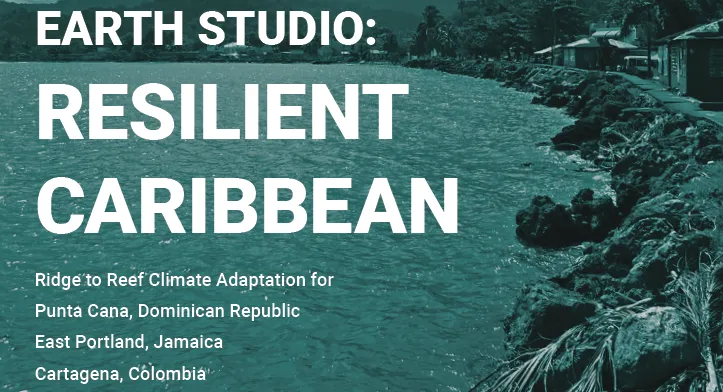
Earth Studio: Resilient Caribbean
Caribbean leaders like Mia Mottley are voicing major concerns on the global stage and can help redefine the priorities and approaches to the global climate crisis and notions of adaptation. And with failures to set international policy to significantly curb greenhouse gas emissions, and global landscapes in varying states of collapse, it is clear that urban design strategies need to scale to the living planet’s massive critical landscapes and the cities that are sustained by them. Political systems are similarly strained, with Caribbean islands facing more extreme Atlantic hurricanes and climate-induced migration. The Caribbean Sea boasts a rich mosaic of mangroves, coral reefs, beaches, lagoons, coastal wetlands, mountain streams and is an intensively productive ecosystem that has sustained human settlements over deep time. It is home to 10% of the world’s remaining coral reefs and home to over 1,000 species of fish that people depend upon for food and tourism. Water quality and temperature changes in the Caribbean threaten tourism, fisheries, and livelihoods across the region.
Throughout the course, we explored positive, regenerative “ridge to roof to reef” visions for sites, integrating ecological imperatives and the built, economic, and social environments. This involved encounters with a reimagination of urban/ riverine and coastal development practices, and foregrounding the notion of a blue decarbonized economy, our collaborations will also aim to expand the concept of working landscapes and emergent urban ecology that advances decarbonization of the Global North, and financial reparations and regenerative urban design for countries of the Caribbean.
We asked: How might ecological restoration, climate adaptation and mitigation, livelihoods, and culture combine across different sites and scales and in the context of the pressures of urbanization.
While the class explored broad investigations of the Caribbean and cities, we also zoomed into three specific sites - the Dominican Republic, Jamaica, and Cartagena - to explore the drivers of vulnerability expressed in the built environment. The sites share many challenges, but the specific research and project frames have been developed in collaboration and consultation with local partners
LINKS TO PUBLICATION
Full Publication (for web viewing)
Introduction
Climate Justice Principles, Context, and AtlasPunta Cana, Dominican Republic
Partners, Workshop, Community Voices, and Urban Design VisionsEast Portland, Jamaica
Partners, Workshop, Community Voices, Design x Climate Framework, and Urban Design VisionsCartagena, Colombia
Partners, Workshop, Community Voices, Design x Climate Framework, and Urban Design VisionsClimate Policy and Practice Overlay
Building Resilient Tourism in East Portland
Climate Reality of Agro-Farming in East Portland
Unlocking Community and Ecosystem-led Water Access and Management
Community Land Trusts in Cartagena: Strategy and Implementation Considerations
Inspiring Regenerative Community Based Mangrove Restoration
Seeds of the Mangroves FundReflections: Experience and Accountability
PARTNERS
IMPLEMENTATION PARTNERS
Ministerio de Turismo de la República Dominicana
Shaney Peña-Gómez
Alligator Head Foundation
Nickie Myers
Markus Reymann
Fundación Grupo Social
Maristella Madero
ACADEMIC PARTNERS
Universidad Nacional Pedro Henríquez Ureña
Mizoocky Mota
The University of the West Indies
Dean Michael Taylor
Thera Edwards
Sherene James-Williamson
Ina Vandebroek
Universidad Tecnológica de Bolívar
Mauro Maza-Chamorro
Pontificia Universidad Javeriana, Bogotá
Jaime Hernandez